
Reviewed · SOWETO & TOWNSHIP TOURS
Johannesburg: The Evolution of Maboneng (Place of Light)
Maboneng means place of light, and this Johannesburg district earns the name through its street art, creative projects, and determined small-business spirit. The most useful part of this tour is the way it connects urban renewal with real city history, from the 1899 Cosmopolitan building to shipping-container housing and public murals.
I like the chance to see Nelson Makamo’s art in an open-air setting, and I like that the route can include Kwa Mai-Mai, one of the city’s oldest traditional healers’ markets. The main caution is value: at $42 for two hours, this is not a cheap stroll, and some advertised stops may be shortened or missed.
Key points before you book
- Maboneng’s creative rebirth: Learn how arts, independent businesses, and new building projects changed part of Johannesburg’s eastern inner city.
- Street art with a story: See murals by local and international artists, including public work linked with Nelson Makamo.
- A mix of old and new: The route brings together the 1899 Cosmopolitan, Drive-lines shipping-container development, and newer creative spaces.
- Traditional healing culture: Kwa Mai-Mai market offers a glimpse of sangomas, traditional medicines, and clothing.
- Strong guide factor: Guides such as Tsepho and Eko have been praised for explaining Maboneng’s origins and history, though the experience can vary.
- Two hours on foot: Wear comfortable shoes, expect a walking-focused tour, and note that the route is not suitable for limited mobility or pregnancy.
Why Maboneng makes a good first look at Johannesburg
Maboneng is not a museum district frozen in one period. It is a working neighborhood that has changed quickly, with new businesses, public art, housing projects, galleries, markets, and older buildings sharing the same streets.
That mix is what gives the tour its purpose. You are not simply ticking off murals. You are looking at how people try to reshape an inner city through art, design, retail, and small enterprise. The results are uneven, which is part of the story. Some projects feel polished, while others feel more improvised.
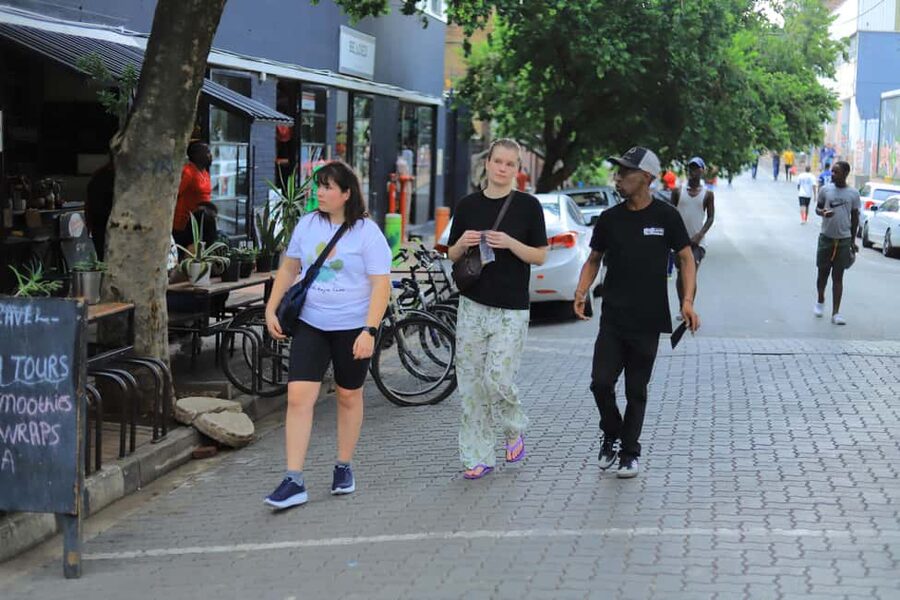
The tour begins at Curiocity Backpackers, 302 Fox Street, in Jeppestown. This is a useful meeting point because the hostel is closely linked with the creative side of Maboneng. From there, you walk with an English-speaking guide through the precinct and its nearby streets.
I would choose this tour early in a Johannesburg stay if you want a basic map of the area and a sense of its character. It gives you context before you return on your own for food, shopping, art, or a rooftop drink.
More Township Tours in Johannesburg
- Johannesburg: Hop-On Hop-Off Bus with Optional Soweto Tour
★ 4.6 · 985 reviews - Soweto /Johannesburg and Apartheid Museum Guided Full Day Tour
★ 5.0 · 932 reviews - Johannesburg Hop-On Hop-Off City Tour with Soweto Option
★ 4.5 · 768 reviews
From Curiocity to Johannesburg’s early suburbs
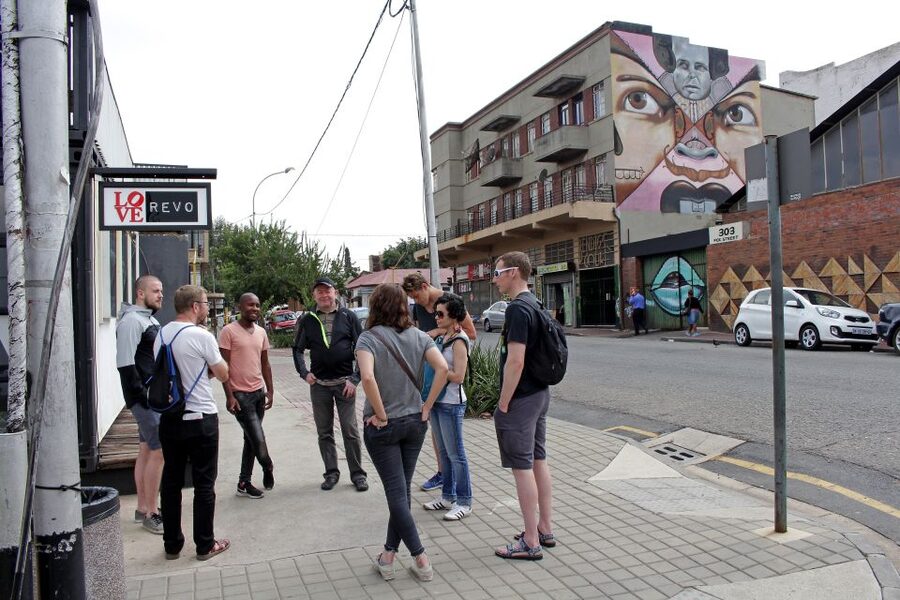
The first part of the walk focuses on the eastern side of downtown Johannesburg and the first suburbs that grew around the city. That background matters because Maboneng’s current identity makes more sense when you understand that this is not a brand-new district.
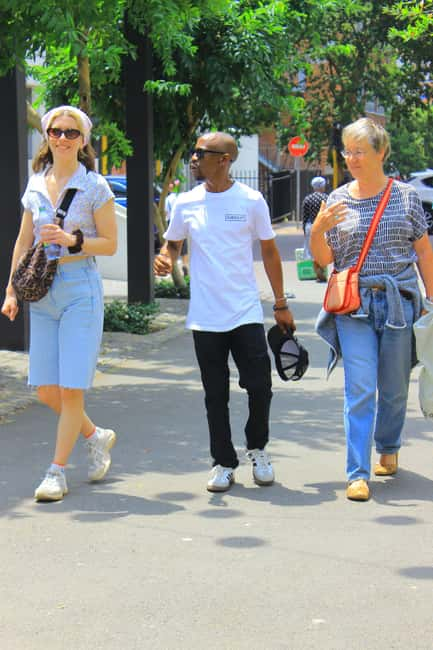
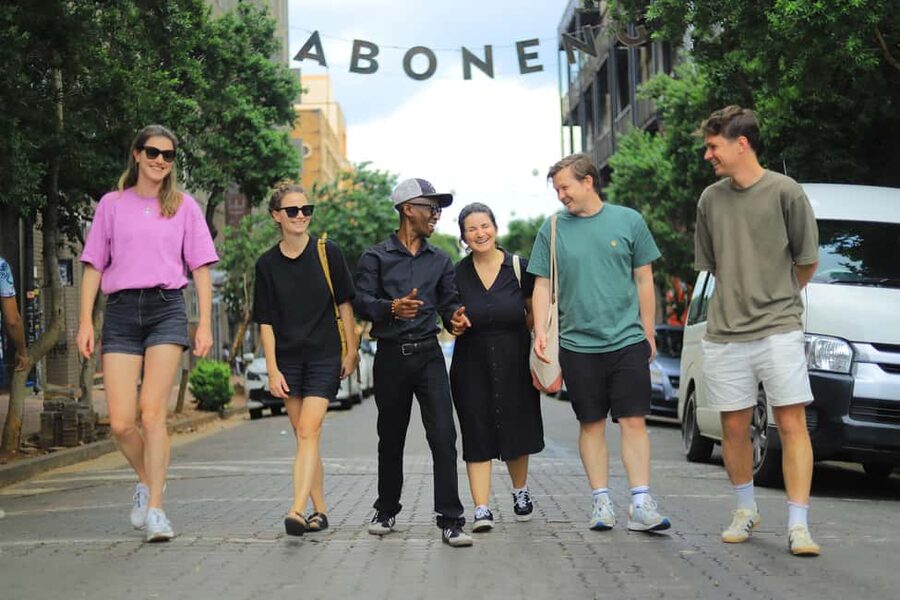
The guide explains how the area developed and how its uses changed over time. You can expect a walking conversation rather than a formal museum lecture. The quality depends heavily on the person leading your group. Tsepho, also spelled Tsehpo in one account, has been praised for explaining the neighborhood and opening access to good viewpoints and art. Eko has also been praised for explaining Maboneng’s origins and history.
That personal element is important. A strong guide can point out why a plain-looking building matters, explain the intent behind a mural, and help you read the neighborhood beyond its fashionable cafés and painted walls. One poor experience included a guide spending too much time on a phone and ending about 20 minutes early, so I would keep your expectations realistic and confirm the route at the start.
The Cosmopolitan and the city’s older face
One of the most memorable buildings on the route is The Cosmopolitan. Built in 1899 and opened as a hotel and bar in 1902, it gives the walk a direct link to Johannesburg’s early urban life.
The appeal is not only its age. The building helps you picture the district before Maboneng became known for art studios, design projects, and weekend activity. Its walls have seen many changes in the city, and the guide uses the site to connect architecture with social history.
Do not expect a long interior visit or a full architectural tour unless your guide confirms one. The value here is the contrast. You are looking at an old heritage building, then moving through streets where new uses and new visual styles have appeared quickly.
This stop also helps prevent the tour from becoming just a street-art walk. The murals are eye-catching, but the older structures show that the area’s story began long before its current creative identity.
Drive-lines and the idea of practical urban renewal
The walk continues to the Drive-lines Development, which uses upcycled shipping containers as affordable housing. It is one of the clearest examples of the tour’s main subject: how entrepreneurial ideas can address urban problems, at least in part.
Shipping containers are not a magic answer to housing shortages, and the tour does not need to present them that way. Their importance is that they show a practical attempt to reuse materials and create new accommodation in a dense city setting.
For you, this stop adds substance to the phrase urban regeneration. You see a physical project rather than hearing only about redevelopment in general terms. It also gives the guide a chance to discuss the gap between creative ideas, affordable living, and the realities of a rapidly changing district.
The walk between locations is part of the experience. This is a street-level tour, so you should expect to spend most of the two hours moving between sites rather than sitting indoors. Comfortable shoes and weather-appropriate clothing are essential.
Other township visits from Johannesburg:
- Half-Day Tour of Soweto Tour
★ 4.5 · 712 reviews - Soweto: Walking Tour with a Local Guide and Lunch
★ 4.9 · 648 reviews - Jo’berg in 1 Day: Soweto, Apartheid Museum & City Tour
★ 4.8 · 524 reviews - Johannesburg: Full-Day Tour with Soweto and Apartheid Museum
★ 4.8 · 478 reviews
Murals, Mandela, and public art as a meeting point
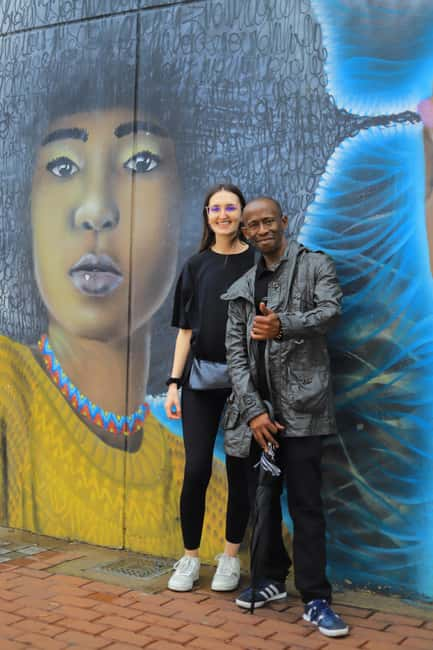
Maboneng’s murals are likely to be the visual high point. The tour includes a stop at the Mandela mural, described as a playful reference to Nelson Mandela as leader and boxer, along with public work by Nelson Makamo.
These murals do more than brighten blank walls. They turn ordinary surfaces into places where history, identity, and local pride can be seen by anyone passing through. The guide explains the work by local and international artists, which gives you more to think about than simply taking photographs.
I especially like the idea of an open-air museum here. You do not need an admission ticket, and the art is part of the neighborhood rather than sealed away from it. At the same time, public art can change, fade, or disappear as buildings and businesses change. The route is therefore less predictable than a gallery visit.
The mural section is also where the tour’s theme becomes clearest. Walls can separate people and places, while public art can invite attention across those divisions. That does not solve the district’s problems, but it changes how you see the streets.
Arts On Main and the creative heart of the precinct
Arts On Main is another major stop. It is associated with South Africa’s celebrated artist William Kentridge and now includes his foundation, The Centre for the Less Good Idea.
The name refers to experimental creative work, and the site helps explain why Maboneng became known as an arts district. You may see how galleries, studios, foundations, and small businesses can give old industrial or commercial spaces a new purpose.
The experience here is likely to be brief within a two-hour route. You should not book this expecting a full gallery program or a long guided tour of every creative space. Instead, treat Arts On Main as a key piece of the neighborhood’s identity and a place that may encourage you to return with more time.
This is one area where the tour can be especially useful for first-time visitors. Without a guide, it is easy to see a fashionable arts complex and miss the larger point about investment, creative work, and the changing use of city buildings.
Kwa Mai-Mai and the older traditions of the city
Kwa Mai-Mai Traditional Healers Market adds a very different note to the walk. It is said to be one of Johannesburg’s oldest traditional healers’ markets, and you may encounter sangomas, traditional medicines, and traditional clothing.
This stop matters because it pushes the tour beyond the polished image of Maboneng. The district is not only murals, cafés, galleries, and new construction. It also contains older forms of commerce and belief that have their own place in Johannesburg’s story.
Approach the market with respect. You are looking at a living place of work and cultural practice, not a staged display created for visitors. Listen to your guide about what you are seeing, avoid littering, and follow local instructions about photography or interaction if those issues arise.
There is one practical concern. The schedule may not always allow a full market visit. One account specifically found that the market was not visited, despite it being part of the expected route. If Kwa Mai-Mai is your main reason for booking, ask at the start whether conditions and timing allow it.
The Collectors Treasure and a satisfying final stop
The Collectors Treasure is described as the largest second-hand bookstore in the southern hemisphere. For anyone who likes old books, browsing here can be more rewarding than a quick souvenir stop.
A large second-hand shop gives you a different view of Johannesburg. Instead of looking only at new creative development, you are surrounded by used objects, past ideas, and printed records. You might find books that help you understand South Africa, art, politics, or the city, though the exact stock will change.
As with Kwa Mai-Mai, timing matters. The tour is only two hours, and the route includes several substantial stops. You may get a short visit rather than enough time for a serious browse. If bookstores are your priority, note the location and return later with more time.
The combination of a healers’ market and a second-hand bookstore is one of the tour’s best ideas. One connects you with living traditions, the other with accumulated knowledge and memory. Together, they make the walk feel broader than a simple redevelopment story.
Rooftop views and the value of the final hour
If time allows, the tour may finish with a sundowner overlooking the Johannesburg skyline. This is not guaranteed as a separate attraction, but it can be a pleasant way to end a walk that has focused on streets, walls, and buildings.
A skyline view gives you a chance to place Maboneng within the wider city. After walking through close urban spaces, you can look back at Johannesburg as a whole and consider how much of the inner city is changing.
Do not base your booking on this final view alone. The wording makes clear that it depends on time, so a delayed start, a longer discussion, or a busy route could remove it from the schedule. Think of it as a possible bonus rather than a fixed part of the experience.
Is $42 fair for two hours?
The price is $42 per person for a two-hour guided walk. That is reasonable only if you value the local explanation, route planning, and added confidence of walking with someone who knows the precinct.
It is less attractive if you measure value by the number of formal attractions visited. Much of the experience takes place outdoors, and several stops may be viewed from the street or covered briefly. One assessment found the cost too high because the activity felt more like a walk than a full tour.
I see the price as paying for interpretation rather than admission tickets. You are paying someone to connect the Cosmopolitan, public murals, Drive-lines, Arts On Main, Kwa Mai-Mai, and the bookstore into one story. If the guide is engaged and the full route operates, that can be worthwhile.
If your budget is tight, compare this with simply visiting Maboneng on your own. The tour makes more sense for a first visit, for solo visitors who want company, or for anyone who would feel more comfortable getting an introduction before exploring independently.
Who should book this Maboneng walk?
I would recommend it to you if you enjoy urban change, public art, architecture, and social history. It also suits anyone who wants a clear introduction to Maboneng without planning a route through several scattered locations.
The walk is best for people who can manage two hours on foot and are comfortable with an unscripted city setting. It is not suitable for people with limited mobility or mobility impairments, and the activity is not recommended for pregnant women.
Bring comfortable shoes, weather-appropriate clothing, and a patient attitude. This is not a tightly controlled museum visit. Stops can vary, the market may not always fit into the route, and the quality of the experience rests partly on the guide.
The tour is offered in English. It starts and ends at Curiocity Backpackers, 302 Fox Street, Jeppestown, Johannesburg, 2043. You can cancel up to 24 hours in advance for a full refund, and a reserve-now, pay-later option is available.
Should you book The Evolution of Maboneng?
Book it if you want context and a local route, not just a checklist of sights. The strongest version of this experience links Johannesburg’s early buildings, new housing ideas, public art, traditional culture, and creative institutions in a compact two-hour walk.
I would hesitate if your main goal is a guaranteed market visit, an artist meeting, or a long stop at every venue. Those elements may not all happen, and $42 feels high when the walk ends early or the guide is not fully engaged.
For a first look at Maboneng, the tour offers a useful framework and some excellent visual moments. Go in knowing that it is a guided neighborhood walk with changing stops, not a formal attraction package, and you will make a better booking decision.
FAQ
How long is The Evolution of Maboneng tour?
The guided walking tour lasts two hours.
Where does the tour start?
It starts at Curiocity Backpackers, 302 Fox Street, Jeppestown, Johannesburg, 2043, South Africa.
Where does the tour end?
The activity ends back at the meeting point at Curiocity Backpackers.
What language is the tour offered in?
The tour is offered in English.
What does the tour cost?
The listed price is $42 per person.
Is the Kwa Mai-Mai Traditional Healers Market included?
Kwa Mai-Mai is part of the planned route, but the market visit may depend on timing and conditions.
Will I see street art on the tour?
Yes. The walk includes murals by local and international artists, the Mandela mural, and public art associated with Nelson Makamo.
Does the tour visit Arts On Main?
Arts On Main is included in the planned route. It is associated with William Kentridge and The Centre for the Less Good Idea.
Is the tour suitable for people with limited mobility?
No. The tour is not recommended for people with limited mobility or mobility impairments.
Can I cancel for a refund?
Yes. You can cancel up to 24 hours in advance for a full refund. A reserve-now, pay-later option is also available.
Just added in Johannesburg
- Soweto Tuk-Tuk Food & Beer Tour★ 5.0 · 9 reviews
- Soweto: Sip & Paint Walking Tour & Take Home a Canvas★ 4.8 · 7 reviews
- Soweto Tour; Mandela House; Vilakazi Street; Market Culture★ 5.0 · 6 reviews
- Soweto & Johannesburg and Apartheid Museum★ 4.7 · 41 reviews
- Soweto Township Tour★ 4.4 · 4 reviews
- Private Soweto,Mandela House,Apartheid Museum,Constitution★ 4.6 · 15 reviews
- Soweto Food & Beer Bike Tour★ 4.9 · 40 reviews
- Johannesburg: Soweto History Tour with Hotel Pickup★ 4.8 · 14 reviews
Soweto & Township Tours, compared.

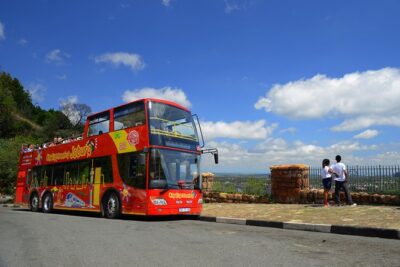
Johannesburg Hop-On Hop-Off City Tour with Soweto Option
Read our review →
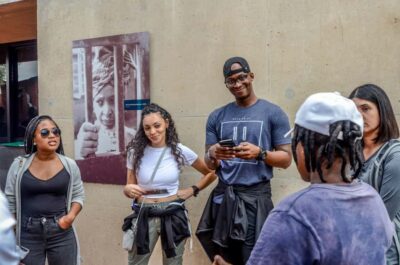

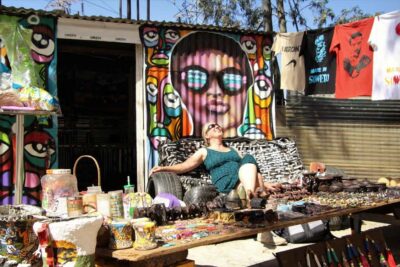
Jo’berg in 1 Day: Soweto, Apartheid Museum & City Tour
Read our review →
Full-Day Tour with Soweto and Apartheid Museum
Read our review →Browse the lists this tour appears in